
A typical case
This is built from the households we work with. A couple in Cape Town has employed the same woman for six years. She cleans and looks after their children four days a week. She is from Zimbabwe and holds a passport. There is no written contract, she is paid in cash, and nobody has ever registered her for UIF. Nobody meant any harm. It just never got done.
What changes when the household signs up
One evening the employer sends a WhatsApp message to our number. She gets a written contract, her pay goes into her own bank account on payday, and a payslip arrives on WhatsApp. UIF comes off her pay every month: 1% from her and 1% from her employer. After six years she has a contract, a payslip and a UIF record for the first time.
Where it breaks
The UIF checks every ID number with Home Affairs, and a passport number fails that check. When a worker on a passport claims, the labour centre creates a number for her at that point. That is the day she has lost her job, and she has to prove a history the system didn’t keep.
“The employers we work with are willing. The workers are paying in. What is missing is a system that can see them.”
How common it is
One worker in six on AskMandla is on a passport, not a South African ID. The law has required foreign workers and their employers to contribute to the UIF since 1 March 2018. The system that records it has not caught up.
What we asked for
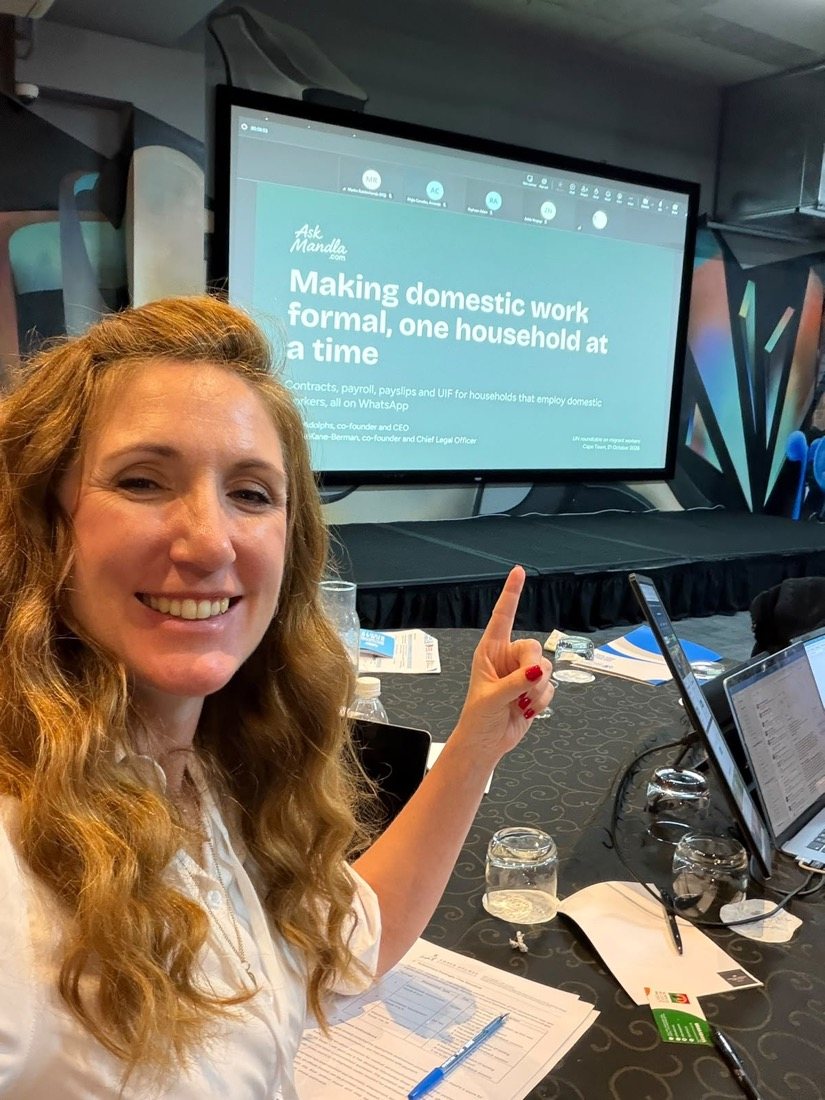
At the UN roundtable on migrant workers, for the Department of Employment and Labour and for the roadmap the roundtable is writing:
- Let the UIF system accept and show declarations under a passport or permit number, so a migrant worker’s history exists before she claims.
- Give registered payroll providers and labour practitioners a bulk registration route, with the employer’s signed consent, in place of an identity quiz that needs the employer on the line.
- Publish one clear list of the documents a foreign national worker and a foreign national employer need for UIF and for COIDA.
If you employ someone on a passport
- Declare her to the UIF every month, even though the system can’t show it yet.
- Keep every payslip. It is the record she will need when she claims.
- Keep a copy of the document that allows her to work, on file.
More in our guide to employing a foreign domestic worker.
What else the roundtable heard
- The Department of Employment and Labour: workers must never pay recruitment fees. The Employment Services Amendment Bill, which would write the fair recruitment principles into law more explicitly, is open for public comment until 16:00 on 6 November 2026.
- OHCHR, the UN’s human rights office: domestic workers often work without a written contract and struggle to get UIF and COIDA benefits. UN committees have told South Africa to formalise domestic work and get labour inspection into private homes.
- The ILO: under its domestic workers convention, which South Africa ratified in 2013, a worker recruited in one country to work in another must get a written contract before she crosses the border.
- What happens next: OHCHR’s roadmaps for domestic and farm workers go for formal endorsement by government and the social partners in 2027.
What we committed to
- Declare every worker on our payroll to the UIF every month, passport holders included.
- Share what we see about where UIF registrations fail, without names, with the Department and the roadmap process.
- Work with UN Women and partners to reach the households that employ migrant women.
- Teach the employers we work with how to employ domestic workers, gardeners and nannies fairly.
- Recommend to every employer on our platform that transport costs go on the payslip as their own line, and go up when fuel prices do.